
WA’s Solar Boom: 110 Megawatts Installed in 3 Months, It’s Biggest Quarter Ever
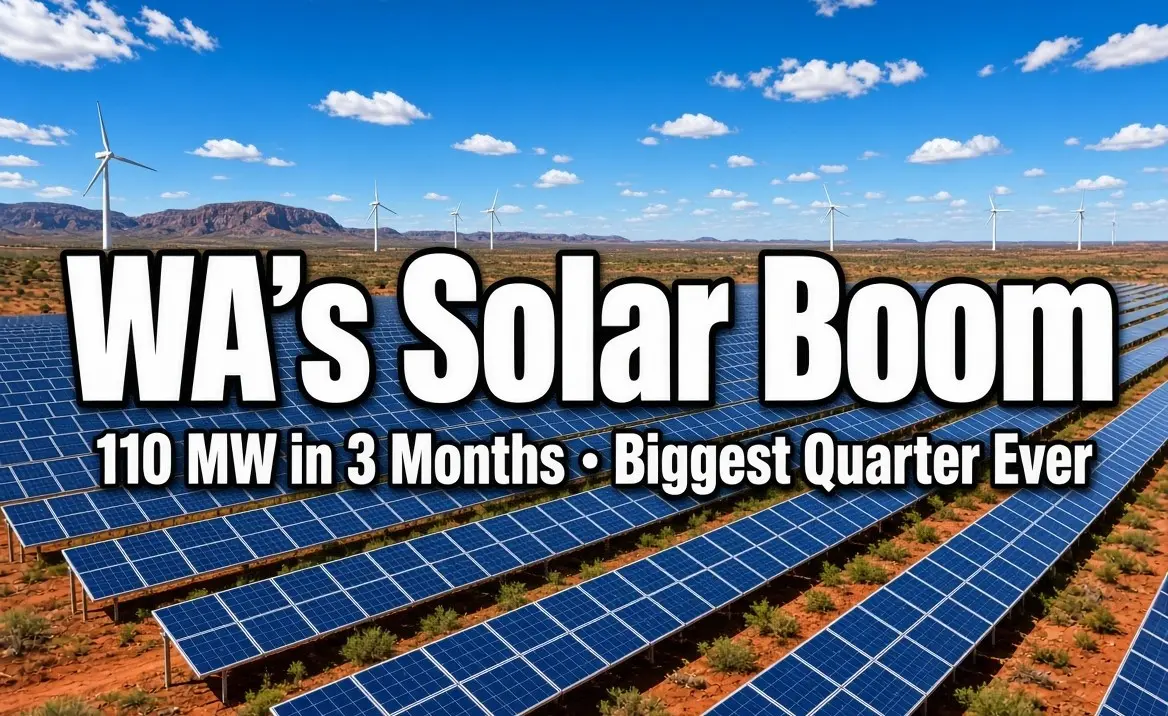
In Western Australia, homeowners and businesses installed more than 110 megawatts (MW) of rooftop solar between April and June 2026, making it the largest quarter for rooftop solar. 110 MW is enough to power about 25,000 homes. WA set a new state record in Australia.
Here is what the number means, what it represents, and what it could mean for you if you are thinking about solar.
1. What does 110 MW actually mean?
A megawatt is a unit of power that measures the maximum power a system can produce. A typical Perth home system is around 6.6 kW, so 110 MW is roughly equivalent to 16,000 average home systems. However, the real mix includes some larger and some smaller systems, as well as business installations. The figure also includes businesses, not just houses. The key point is that it was installed in just three months, which makes it the strongest quarter WA has recorded.
2. Why did it happen?
Recently, the Federal Cheaper Home Batteries program was reduced on 1 May 2026. People are installing solar systems before this rebate reduction. In April, more than 80% of homes had installed solar systems, according to the Clean Energy Regulator's report. The home battery program provides a significant boost to the Australian solar market.
That finding is for Australia as a whole, so WA’s mix may differ slightly, but the pattern is clear.
Other things are also helping:
Low feed-in tariffs motivate people to install a solar battery and store their generated solar power rather than export it.
Day by day, electricity prices are rising, affecting public financing.
The government also provides flexible finance options such as interest-free loans, along with rebates and incentives.
3. Batteries are growing as fast as solar
The solar boom came with a battery boom. WA has now passed 50,000 home batteries installed through the Cheaper Home Batteries Program, adding more than 1.1 gigawatt-hours (GWh) of storage. Nationally, the April to June quarter also set a record for batteries, with more than 111,000 approved batteries and about 3.6 GWh of capacity.
For homeowners, this is a sign of a shift. Solar used to mean panels only. Now, many people buy panels and a battery together so they can use their solar power in the evening, when prices are highest, and the panels are not producing.
4. Community batteries for people without solar
Not everyone can put panels on a roof. To share the benefits, WA is building community batteries. Five are already running, providing 2.8 MWh of storage, and 18 more (14.8 MWh) are due to come online over the next 12 months. They store extra solar from nearby homes and let others in the area benefit from it.
5. Bigger projects are coming too
Large projects are being built alongside the rooftop boom. Ten regional WA projects under the federal Capacity Investment Scheme are expected to add about 1.9 gigawatts (GW) of new renewable generation and 482 MW of large-scale battery storage. Across Australia, large-scale solar investment also hit a record in the same quarter.
6. How does this affect the grid?
WA’s main grid, the South West Interconnected System (SWIS), is one of the largest isolated grids in the world. It cannot import power from neighbouring states, so managing large amounts of rooftop solar is a real challenge. On sunny days, rooftop solar can supply a very large share of power, pushing the grid’s daytime demand to low levels. Batteries help here by storing midday solar energy and releasing it in the evening. This is a big reason the state supports home and community batteries.
7. What does this mean if you are thinking about solar?
Demand is high: A busy market can mean longer waits for installation and Western Power approval, so plan.
Use your own power: WA’s export rate is low, so the best savings come from using the solar you generate.
Think about a battery: If you use a lot of power in the evening, it might suit you. Compare the size to your actual use.
Check the dates: The federal battery rebate is due for review in January 2027. Rates and rules can change, so confirm the current figures with your installer.
Choose an accredited installer like Solar 365. To get rebates, the installer and the equipment must be approved. Get at least three quotes and ask for the rebate to be deducted upfront.
The bottom line
WA’s record 110 MW quarter shows how quickly the state is moving to solar and batteries. Rebates, high power prices and plenty of sunshine are all pushing households in the same direction. If you are thinking about solar, it is a good time to compare quotes, but make sure you choose a system size and battery that match how you actually use electricity.