
Solar Sharer Isn't Available in WA: How to Get Similar Midday Savings With Your Solar
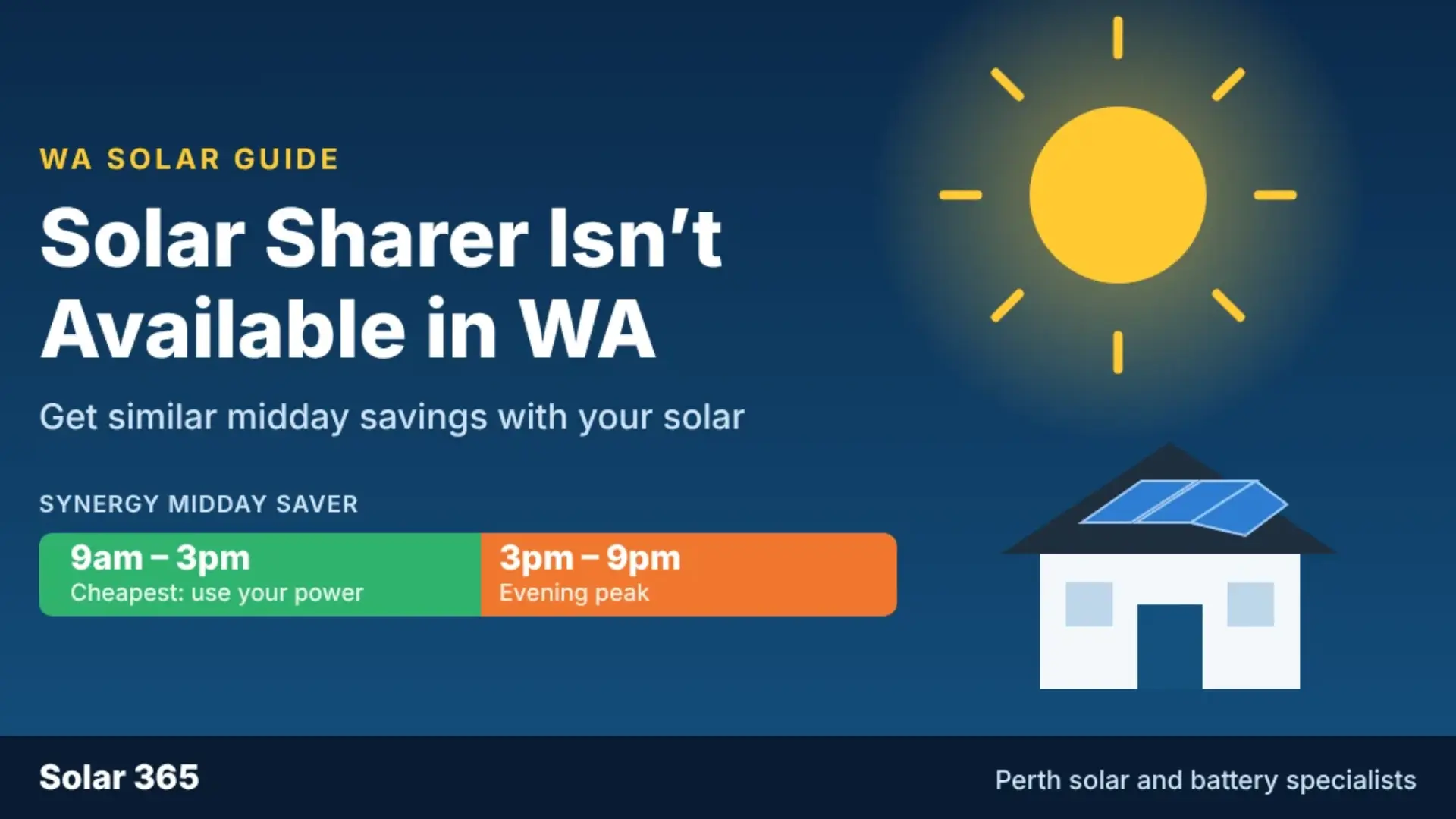
If you have been reading about the new free midday power offer, it started on 1 July 2026, but it only applies to New South Wales, South Australia and south-east Queensland. Western Australia is not covered.
The good news is that Perth households already have a local option that rewards the same habit: using your power in the middle of the day, when your solar panels are producing the most. This guide explains what is on offer in WA and how to use your solar monitoring dashboard to see whether your home is making the most of it.
What is the Solar Sharer Offer?
The Solar Sharer Offer is an optional electricity plan that provides eligible households with three hours of free electricity each day around midday, capped at 24 kWh per day. In NSW and south-east Queensland, the free window is 11 am to 2 pm. In South Australia, it runs from 12 pm to 3 pm. A smart meter is required to participate, and power used outside the free window is charged at regulated rates, so it is not automatically cheaper for every household. Victoria started a similar scheme, the Midday Power Saver, on 1 October 2026.
The idea behind it is simple. Millions of rooftop systems push more power into the grid at midday than the grid needs, and cheap or free daytime power encourages people to use that energy rather than waste it.
How much savings will I get in Perth?
The cost of electricity in Western Australia is state-regulated, not under the national scheme through which Solar Sharer operates. That means the federal government cannot just extend the scheme to WA. We have heard about a possible consultation with WA to offer something similar, but nothing is confirmed. Perth households should not plan around this.
What WA has instead: Synergy's Midday Saver
Synergy's Midday Saver is a time-of-use plan built on the same principle. Grid power is cheapest in the middle of the day, from 9 am to 3 pm, and more expensive during the evening peak from 3 pm to 9 pm. Like Solar Sharer, it needs a smart meter.
The plan only works in your favour if your habits match it. If most of your power use occurs in the evening and you make no changes, a time-of-use plan can cost you more than a flat rate. That is where your solar dashboard comes in.
Please check Synergy's website for the current rates and eligibility before switching, as tariffs change from year to year.
The five numbers worth checking
Generation: How much did your panels produce over the course of the day? This usually peaks between 10 am and 2 pm in Perth, depending on your panel orientation.
Self-consumption: How much of that solar power does your home use directly instead of sending it to the grid? A higher share means more of your own power is working for you.
Export: How much solar power went to the grid? Perth feed-in tariffs are low, with Synergy paying 2c per kWh before 3 pm and 10c per kWh from 3 pm to 9 pm, so large midday exports often mean a missed opportunity.
Grid import by time of day: When you buy power from the grid. If most of it falls between 3 pm and 9 pm, that is where the cost sits.
Battery state of charge: If you have a battery, this shows whether it is full by mid-afternoon and how long it lasts into the evening.
A typical day, before and after
Take a home with a 6.6 kW system where nobody is home during the day. The dishwasher, washing machine and air conditioning run in the evening. The dashboard shows strong generation at midday, a large export spike, and heavy grid import after 3 pm. Most of the solar power leaves the house, and most of the power the household pays for is bought at the highest rate.
Now change a few habits. The pool pump, dishwasher and washing machine are set to run between 10 am and 2 pm. Hot water heats at midday. The air conditioning pre-cools the house before the afternoon peak. On the dashboard, the export spike shrinks, self-consumption increases, and evening grid imports drop.
Here is how the same readings change for the home above. Label names differ between apps, so look for the closest match in yours.
Dashboard reading | Where to find it in your app | Before load shifting | After load shifting |
|---|---|---|---|
Solar generation | Day view, solar or PV line | Peaks around midday | Same, weather permitting |
Self-consumption | Energy summary, often called self-use or solar used at home | Low, most solar goes to the grid | More solar is used at home |
Export to grid | Day view, feed-in or exported line | Large spike from 10 am to 2 pm | Smaller spike |
Grid import, 3 pm to 9 pm | Day view, grid purchase or imported line | Heavy | Lower |
The exact numbers vary from home to home, so we would rather show you a real dashboard than promise a figure. Your own app will show you the same pattern within a week or two.
Where does a battery fit?
A battery stores the solar power you do not use at midday and releases it in the evening, when grid power costs the most. On a time-of-use plan, you can reduce how much you buy at peak rates. It is not the right answer for every home, though. If you are already home during the day and can shift most of your usage, you may not need one. If your household is out all day and uses most of its power after dark, a battery usually makes more sense.
Your dashboard can help you decide. Look at your daily export and your evening import. If you export a lot at midday and import a lot at night, a battery is storing a gap that already exists. We install FoxESS, Growatt, Sigenergy, Alpha ESS, GoodWe, Huawei and Tesla Powerwall 3 batteries, and we can size one based on your real usage data.
Simple ways to move power use to midday
You do not need a smart home setup to do this. Most households can start with the following:
Run the dishwasher, washing machine and dryer on a timer between 10 am and 2 pm.
Set the pool pump to run in the middle of the day.
Heat hot water at midday if you have an electric or heat pump system.
Pre-cool or pre-heat the house before 3 pm.
Charge an electric vehicle at midday if you can, rather than overnight or in the evening.
Talk to our team
If you would like help reading your solar system, or you are comparing batteries or a new system for Perth, contact Solar 365 for a free consultation. We install solar systems across Perth, including Solar Panels Canning Vale, Solar Panels Ellenbrook and Solar Panels Baldivis. Call (08) 6119 3653 or request a quote on our website.