
What is the Solar 120% Rule? [Simple Explanation]
![What is the Solar 120% Rule? [Simple Explanation]](https://www.solar365.net.au/api/uploads/images/What-is-the-Solar-120--Rule-1774855202302-718959335.webp)
The 120% rule is a safety guideline from the National Electrical Code (NEC). It ensures that your home’s electrical switchboard can safely handle the combined current from the grid supply (main breaker) and the solar system (solar breaker).
Note: Electricity and current are different; electricity is the overall energy, while current is the flow of that energy through a circuit.
If you don’t understand, contact solar installation experts for a detailed explanation.
In simple words:
When a solar system is connected to your home switchboard, the total current from your main breaker (from the grid) + the solar inverter (breaker) must not exceed 120% of the switchboard. Your home’s electrical board can carry a certain amount of current capacity. Your house already uses some electricity from the grid, and solar panels will add extra electricity to the same switchboard. The total amount of electricity does not exceed than 120%, if it happens, then your switchboard heats up more and can be destroyed. It is a safety rule that prevents the main switchboard from overheating.
Although the 120% standards rule is defined in the National Electrical Code (USA), and Australian solar installations follow similar safety guidelines under AS/NZS standards to prevent switchboard overloading.”
For example:
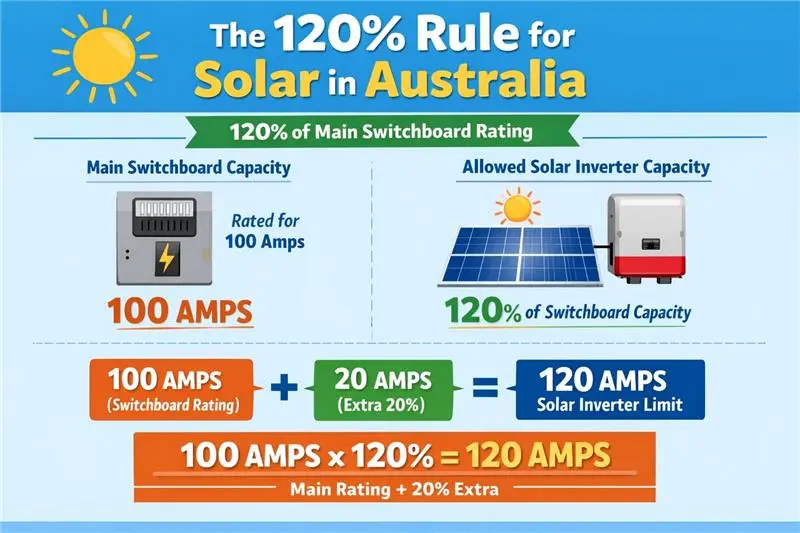
If your switchboard has a 100 amp rating busbar:
1.120% of 100A = 120 amps
2. The rule is based on this calculation: Main Breaker Amps + Solar Breaker Amps ≤ 120% of Busbar Amps
3. If your home has a 100A main breaker, the solar breaker should be of 20A to comply with safety guidelines.
Visual Guide: Solar 120% Rule for Homeowners
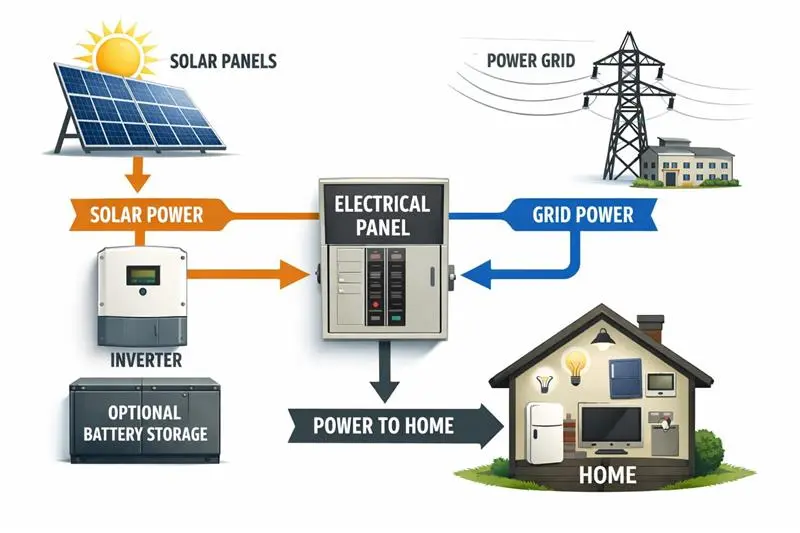
Solar energy comes from the solar panels to the solar inverter, which converts the solar energy into usable energy for the home. Then it goes to the electrical panel ( main switchboard). If your solar panels produce extra energy beyond your home's energy needs, you can store it in a solar battery.
On the other hand, electricity comes from the grid to the electrical panel. Now, the electrical panel supplies the electricity to your home as you need. Firstly, it supplies the solar energy, but if the energy is not enough for your needs, then it absorbs the electricity from the grid and supplies it to your home. The total amount of electricity is not more than 120%.
Why the 120% rule matters
Prevents overloading: Every home has a switchboard that has its own electricity limit. Let's assume the switchboard limit is 100 amps. When you install a solar system, power comes from both the grid and the solar system, which means too much power at the same time for your home. This causes overheating and can be dangerous.
Avoids fire risk: If too much power comes from both sides, it can be a risk of fire or melt the wires. 120% rule helps to ensure power comes in a safe capacity.
Standard safety rule: It is a safety rule in Australia. Electricians must follow this rule before installing a solar system at your home, and it is also your responsibility to understand the 120% rule.
Reduces maintenance issues: Keeping current within limits minimizes wear and tear on wiring, reducing the chances of future repairs.
Improves system reliability: A properly balanced system runs more efficiently and delivers consistent performance without electrical stress.
Ensures safe solar integration: It allows solar systems to be connected without upgrading the entire switchboard in many cases, while still maintaining safety.